
Short answer: To open a sole proprietorship as a motorcycle courier, you notify the tax office that you are starting business, receive a tax certificate after the address inspection, your Bağ-Kur (self-employed social security) registration starts automatically and you set up e-Archive invoicing. With documents ready the process usually takes about a week. After that you file a VAT return and pay Bağ-Kur every month, and prepare an income tax return once a year.
Most food, grocery and parcel delivery platforms work with couriers on an invoice basis. That requires the courier to be a taxpayer, which in practice means opening a sole proprietorship. For a first-time taxpayer the process can look complicated, but the steps are clear, and in the right order you can start working within a few days.
Drawing on our work with couriers in Ankara, this guide covers the opening steps, the documents needed, monthly obligations and the costs you can deduct as expenses.
What to prepare before you start
- ID and e-Devlet password: Most applications are made online.
- Business address: If you have no separate premises, your home address can be registered as the business address. Tenants need their lease; owners need title deed details.
- Bank account: An account and IBAN in your own name for platform payments.
- Motorcycle and licence details: The vehicle registration and your driving licence; if the vehicle is in your name, deducting costs and depreciation is easier.
- Documents the platform asks for: Most platforms ask for a tax certificate, ID, IBAN and sometimes a criminal record certificate.
Opening a sole proprietorship step by step
1. Choosing the activity code
Courier activity is registered under a suitable code in the postal and courier activities group (NACE 53.20). The right code affects everything from the VAT rate to chamber registration, so it should not be chosen at random.
2. Notifying the tax office
You apply through the Revenue Administration’s digital channels or at the tax office for your address. Your accountant can also file this notification for you. Starting business must be notified within ten days of the date you begin.
3. Inspection and tax certificate
The tax office inspects whether you actually operate at the address you declared. Once the inspection is completed, your tax number becomes active and you can download your tax certificate from the online tax office.
4. Bağ-Kur registration
Once your tax registration is created, your SGK 4/b (Bağ-Kur) insurance starts automatically. No separate application is needed, but you must pay the monthly premiums regularly. Since the one-year Bağ-Kur premium support for young entrepreneurs was abolished from 1 January 2026, newcomers also pay their premiums from the first month. You can see an estimate with our Bağ-Kur premium calculator.
5. Chamber registration
Couriers usually operate as tradespeople, so they register with the relevant tradespeople’s chamber and the Tradespeople and Craftsmen Registry. Which chamber you join depends on your activity code.
6. e-Notification and e-Archive invoicing
Correspondence from the tax office is sent by e-Notification. To issue invoices you apply to the Revenue Administration’s e-Archive portal; it is free and can be used the same day. We explain the difference between e-Invoice and e-Archive in this article.
7. Setting up on the platform
You upload your tax certificate, IBAN and invoice details to your account on the platform. The platform tells you which period and amount to invoice.
| Step | Where | Typical time |
|---|---|---|
| Notification of starting business | Online tax office or tax office | 1 working day |
| Inspection and tax certificate | Tax office | 1–3 working days |
| Bağ-Kur registration | SGK (automatic) | With tax registration |
| Chamber and registry | Tradespeople’s chamber and registry | 1–2 working days |
| e-Archive application | GİB e-Archive portal | Same day |
| Platform setup | Platform account | 1–3 working days |
Durations are typical ranges we have observed for openings in Ankara and may vary with the tax office’s workload. Some steps run in parallel, so the total rarely exceeds a week.
What happens every month after opening?
Once the business is open, the real work is regular follow-up. Most couriers keep a business ledger under the real method and follow this calendar:
| Obligation | Frequency | Deadline |
|---|---|---|
| e-Archive invoice to the platform | In periods set by the platform | Per the platform calendar |
| VAT return and payment | Monthly | 28th of the following month |
| Bağ-Kur premium | Monthly | Last day of the following month |
| Provisional tax | 3 periods a year | 17 May, 17 August, 17 November |
| Annual income tax return | Once a year | End of March |
Courier services are subject to the standard 20% VAT rate. The VAT you paid on expenses such as fuel and maintenance is deducted from the VAT on your invoices, and you pay the difference. Some platforms may ask for VAT withholding on the invoice; in that case the invoice follows the platform’s instructions. Try the calculation with our VAT calculator.
Which costs can be deducted?
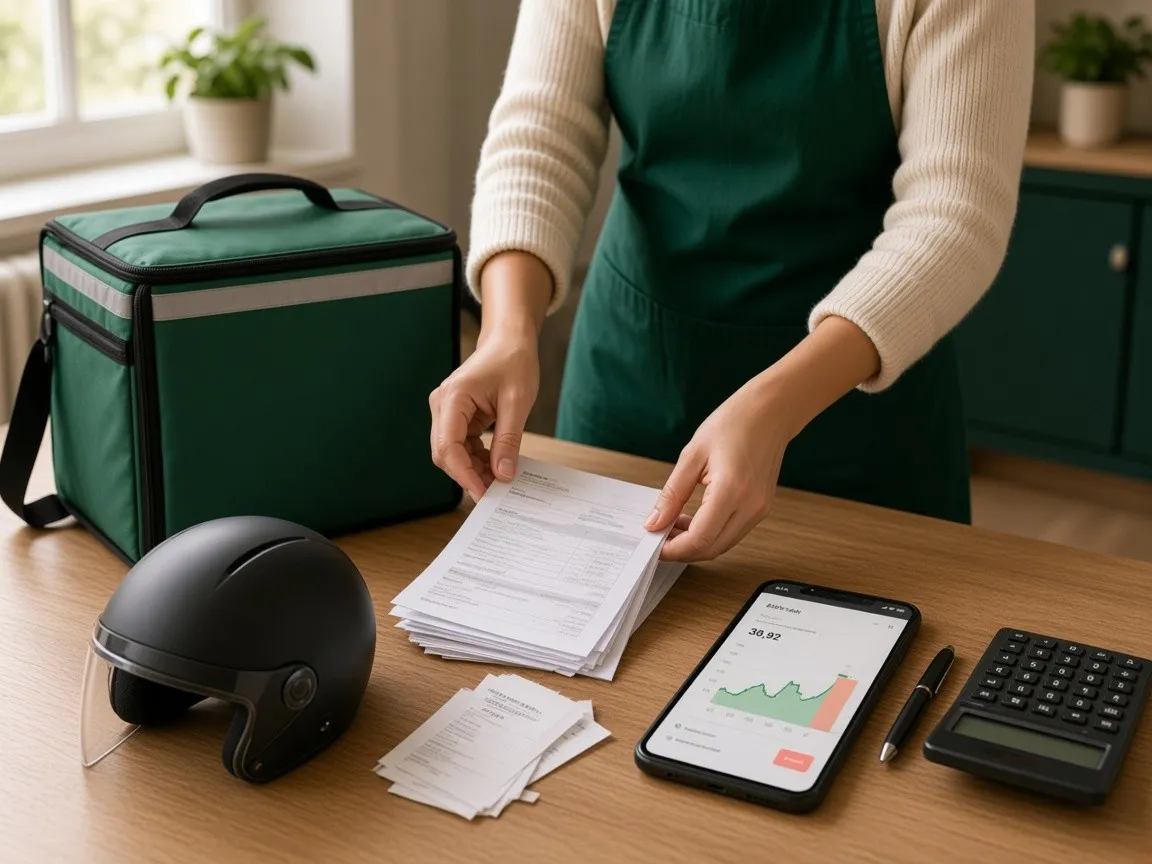
A courier taxed under the real method can deduct costs directly related to the work, provided they are documented with an invoice or receipt issued in their name:
- Fuel, motorcycle maintenance, tyres and spare parts
- Work equipment such as a helmet, jacket, gloves and rain gear
- Mobile phone bill and mobile data used for work
- Motorcycle comprehensive insurance, compulsory traffic insurance and motor vehicle tax
- Depreciation of the motorcycle if it is registered to the business
- Accounting fees and bank charges
Make sure your tax number is written on the receipt. A receipt without it is not accepted as an expense.
The four most common courier mistakes
- Not collecting receipts: Without fuel and maintenance receipts, all revenue is taxed as if it were profit and the tax paid rises unnecessarily.
- Putting off Bağ-Kur premiums: Unpaid premiums grow with late-payment interest and can block access to healthcare.
- Invoicing a different amount from the earnings statement: If the invoice does not match the amount the platform reports, payments are delayed.
- Mixing personal and business spending: Without a separate account it is hard to tell at month end which payments belong to the business.
All of these mistakes can be avoided with small habits. Photographing receipts during the month and sending them to your accountant reduces month-end work to almost nothing.
Is there a tax exemption?
The most discussed topic among couriers is the “courier tax exemption”. In short, there is no general exemption for couriers invoicing a platform; however, couriers under 29 who become taxpayers for the first time may qualify for the young entrepreneur income exemption. We cover this, along with misinformation circulating online, in courier tax exemption.
Frequently asked questions
How long does it take to open a courier sole proprietorship?
With documents ready, the notification, inspection, chamber registration and e-Archive application are usually completed within a week. The inspection date depends on the tax office’s workload.
Can I open a sole proprietorship at my home address?
Yes. If you have no separate premises, your home address can be registered as the business address. Have your lease ready if you rent, or title deed details if you own.
Do I have to pay Bağ-Kur premiums?
Yes. Your Bağ-Kur insurance starts with your tax registration and premiums become due. If you are employed with SGK insurance in another job the situation differs; check which insurance applies before opening.
How many invoices does a courier issue?
It depends on the platform’s payment period. Most platforms ask for one invoice per weekly or monthly earnings statement. The invoice amount must match the earnings the platform reports to you.
Can I deduct costs if the motorcycle is not in my name?
Work-related costs such as fuel and maintenance can be deducted as long as they are documented in your name. For items such as depreciation and insurance, the vehicle must belong to your business or be used under a rental agreement.
How do I close the business if I stop courier work?
You notify the tax office that you have ceased business, file the final returns and your Bağ-Kur registration closes. If you forget, filing and premium obligations continue, so tell your accountant as soon as you decide to stop.
Do I have to hire an accountant?
Legally you can file your own returns. In practice, working with a certified public accountant for bookkeeping, VAT, expense tracking and deadlines is much safer and often cheaper.
Summary
Opening a sole proprietorship as a motorcycle courier takes about a week in the right order: notification of starting business, inspection, tax certificate, chamber registration, e-Archive and platform setup. What really matters is keeping invoices, expenses and returns in order every month afterwards.
For couriers working in Ankara we handle everything from opening to monthly filings for a fixed monthly fee. See how accounting fees are set in accountant fees in Ankara, or get in touch to open your business.
Platform terms and tax rules change from time to time. Reviewing invoicing and payment terms with your accountant before starting with a new platform prevents corrections later.