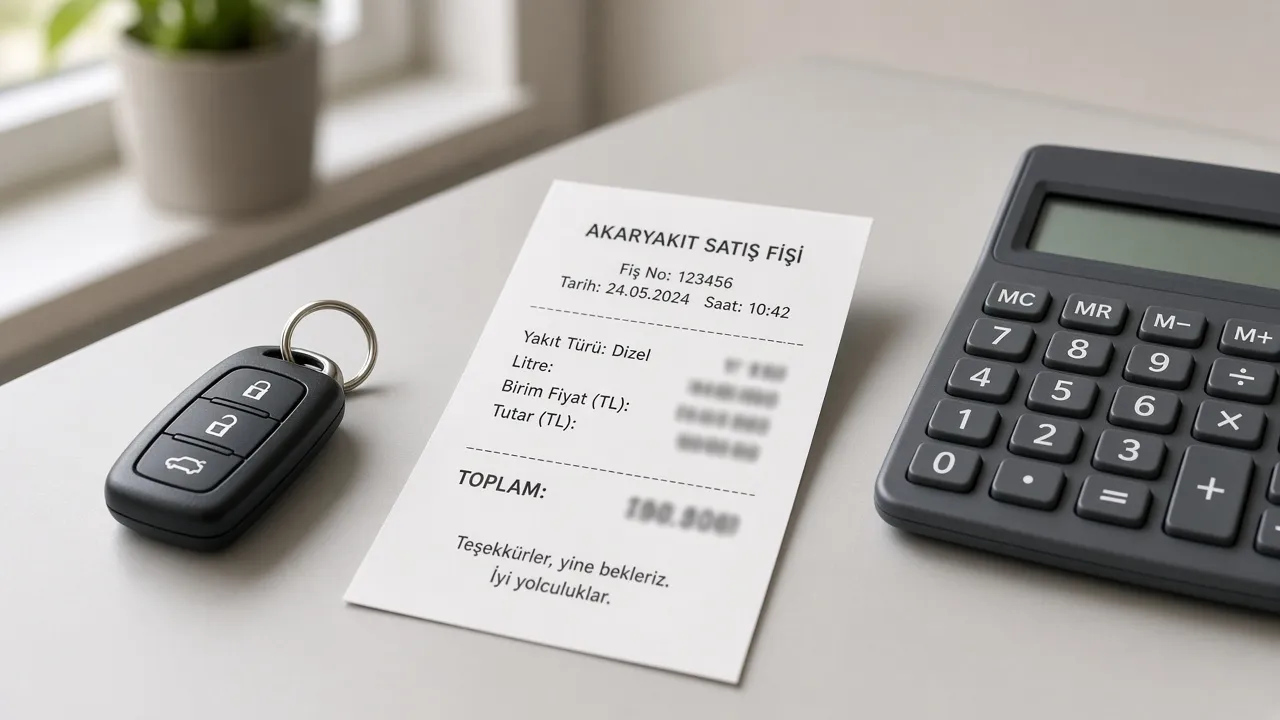
Short answer: A company plate opens an expense door; it does not fill it to 100 percent. For passenger cars, at most 70 percent of running costs — fuel, maintenance, casco, parking, tolls and similar — is deductible; the rest is legally non-deductible. Lease payments follow a monthly amount cap, not the 70 percent rule; depreciation follows its own cost caps. In 2026 the lease cap is TRY 46,000 a month excluding VAT, the ÖTV+VAT expense cap is TRY 1,200,000, and depreciation cost caps sit at TRY 1,380,000 / 2,600,000. Motor vehicle tax on passenger cars is not deductible. Holiday and family miles sit on personal / partner current account.
The sentence on our Kızılay desk is clear: “The car is in the company’s name — we expense all the fuel, right?” The same sentence picks up casco, HGS, a monthly leased SUV and a Bodrum holiday. The answer does not fit on one receipt. Passenger or commercial class, running cost or lease or depreciation, work route or holiday — four different lines.
This guide sorts the passenger-car limits for limited-company and sole-prop files. Uber on the card sits in ChatGPT and Uber. Cash into your pocket sits in taking money from a limited company. Monthly books sit under bookkeeping.
What is a passenger car, who is capped?
The cap applies to passenger cars other than those used by businesses whose activity is partly or wholly renting or operating passenger cars for that purpose. A software limited’s manager car, a consultant’s sedan, a trader’s family hatchback show up here often. Panel vans and trucks that are not passenger cars may sit outside the 70 percent pack; class follows the registration and use.
The rule runs for trade income, professional income and the corporate tax base. “We are a limited company so we are free” does not erase these limits.
Which limits in 2026?
| Item | 2026 frame | Non-deductible / note |
|---|---|---|
| Running costs (fuel, maintenance, insurance, parking, tolls, interest…) | At most 70% | 30% non-deductible |
| Monthly lease (excl. VAT) | Up to TRY 46,000 | Excess + related VAT |
| ÖTV + VAT on purchase (if expensed) | Up to TRY 1,200,000 | Excess |
| Depreciation base (first cost excl. ÖTV/VAT) | TRY 1,380,000 | Depreciation on excess base |
| Depreciation (taxes in cost / second-hand) | TRY 2,600,000 | Depreciation on excess |
| Motor vehicle tax (passenger) | Not deductible | All (rental-fleet exception reserved) |
The amounts were revalued for 2026 by Income Tax General Communiqué No. 332. For depreciation, the cap in force on the acquisition date matters; for leases, the year of the month the rent belongs to. Rates can change — check the communiqué on filing day.
Fuel and maintenance: the 70 percent door
Fuel, maintenance, tyres, casco, traffic insurance, parking, bridge and motorway tolls, and vehicle-loan interest booked as a direct expense enter the passenger-car running-cost pack at 70 percent. Even with an invoice in the company / business name, 30 percent is added back (non-deductible). “It was all for work” does not turn 70 into 100.
The lease payment itself is not under the 70 percent rule; it sits under the monthly TRY 46,000 (excl. VAT) cap. Fuel on a leased car is still under 70 percent. Financial leases follow depreciation / interest rules instead of the monthly rent cap.
Sample figures. Your receipt total and vehicle class control.
Personal use and holidays
A company plate does not make the whole Bodrum road a business expense. Family-holiday fuel, supermarket parking, school-run routes — with no business link — land on personal / partner current account. The 70 percent rule does not bless personal miles; business link comes first, then the passenger-car cap.
A car allocated to staff or a partner with unlimited personal use can open a wage-benefit discussion. Odometer / fuel-card dumps carry the file. Uber sorting is in the expense guide; cash-out doors sit in salary dividend current account.

Purchase, lease, depreciation in brief
If you expense ÖTV+VAT on a purchase, the 2026 cap is TRY 1,200,000 per car. For depreciation, first cost excluding ÖTV/VAT is capped at TRY 1,380,000; if taxes are in cost or the car is second-hand, TRY 2,600,000. Depreciation on the excess base is non-deductible. The 70 percent rule does not apply to depreciation.
On a leased passenger car, rent above TRY 46,000 a month is not deductible; VAT on the excess is not recoverable and is treated as non-deductible. A second car carries the same per-vehicle caps — fleets need a working paper.
What should you do? (short checklist)
- Write the registration class: passenger car or outside the pack?
- At month-end split fuel/maintenance/insurance into 70 percent deductible and 30 percent non-deductible.
- If leased, check the TRY 46,000 excl. VAT monthly cap.
- Put holiday and family miles on current account / private — do not force them into the 70 percent.
- Do not treat motor vehicle tax as a passenger-car expense; read depreciation caps by acquisition year.
For a new company car, first-month plate and card names sit in the first-year checklist. Ankara formation is in company formation. Clarify a foggy fleet under tax advisory with the statements.
Fuel card and registration on one desk
This split does not end in a screenshot; registration, fuel-card dump and lease contract must sit together. At our Kızılay office on Atatürk Bulvarı, Meşrutiyet Mah. No: 105/815 we sort the last three months of passenger-car lines into 70 percent / non-deductible. Directions: Google Maps — office. What to bring is on the first-meeting list.
Frequently asked questions
Is all company-car fuel deductible?
For a passenger car, no. At most 70 percent of running costs is deductible; 30 percent is non-deductible. Holiday fuel is also personal / current account.
What is the 2026 lease cap for a passenger car?
Up to TRY 46,000 a month excluding VAT may be deducted. The excess and related VAT are calculated separately.
Does the 70 percent rule apply to depreciation too?
No. Depreciation follows its own cost caps; 70 percent is for running costs.
Is motor vehicle tax deductible?
On passenger cars it is generally not deductible. An exception for cars rented out by rental businesses is reserved.
Is a panel van under 70 percent too?
Vehicles that are not passenger cars may sit outside this pack. Registration class and use decide.
Is limited different from sole prop?
The passenger-car cap runs on both sides. Name and documents are read more strictly in a limited company; the percentage family is the same.
In short
On a company passenger car, fuel and maintenance go in at 70 percent; lease, depreciation and ÖTV/VAT have separate caps. In 2026 lease is TRY 46,000 and depreciation bases TRY 1,380,000 / 2,600,000. The plate is not enough; holiday miles hit the current account.
At Ankara Muhasebeci in Kızılay we separate registration, fuel and the non-deductible line in one file. Location: Google Maps. To talk, get in touch, or see bookkeeping and tax advisory.
One line: a company car opens expense room; passenger-car rules close the door at less than 100 percent.